12 Mistakes That Are Killing Your Webinar Conversions

12 Mistakes That Are Killing Your Webinar Conversions

12 Mistakes That Are Killing Your Webinar Conversions

Most webinars do not get clients. Here is why.

I review over 600 webinars a year. I also run more than 200 webinars a year for my own business. After all of that, I can tell you that the same mistakes show up again and again and they add up and they kill conversions.


Want to build a webinar that converts?

The Webinar Conversion Kit shows you how to create your full webinar presentation in a few hours.

[CLICK HERE TO GET THE WEBINAR CONVERSION KIT]


Mistake 1: Reading From a Script or Sounding AI-Generated

AI tools help you write faster. That is great. The problem starts when your webinar sounds like a robot wrote it and a robot is delivering it.

People buy connection. When you read from a script, you stop looking into the camera. You stop sounding human. Your audience can feel it straight away, and they switch off. What people want to buy is a piece of you. Your energy, your belief, the way you see things.

Use talking points on your slides instead of a full script. If you know your subject well enough to teach it, you know it well enough to talk about it naturally. One keyword or phrase per slide gives you all the direction you need.

Mistake 2: Too Many Calls to Action

I worked with a client who had 80 to 100 people showing up to every webinar. Good numbers. But they only booked two or three calls after each one.

When we looked at their sales page, it had five different calls to action. Book a call. Subscribe to YouTube. Follow the podcast. Download a free course. Enter a giveaway. Five options means nobody picks one.

Give people one thing to do. Pick the action that matters most and point everything toward it. Repeat it several times throughout the webinar. Make it simple to take.

Mistake 3: A Weak or Missing Personal Story

Some presenters turn their whole webinar into a biography and that gets old fast. But the opposite mistake costs just as many sales. Some people strip out their story completely because they do not want to seem like they are making it about themselves.

Your audience needs a reason to buy from you specifically, not just someone in your field. Your story gives them that reason.

The goal is to tell the story where your audience sees themselves in you. They need to see their own struggle in your past and your solution in their future. When that connection lands, the sale follows naturally.

Mistake 4: Your Energy Drops During the Pitch

You start the webinar full of energy. You are sharp, warm, connecting well. Then you deliver your content for 45 minutes and by the time you get to the call to action, you have nothing left.

The pitch is the worst possible moment to run out of energy. Your audience makes their buying decision right there. If you sound flat and done, they feel it and they say no.

One fix that works well is placing a powerful image or client story near your pitch slides. Pick something that genuinely moves you. When you see it and tell the story, your energy comes back naturally. You trigger a real response right when you need it most.

Mistake 5: Not Enough Audience Interaction

A webinar is a conversation, not a lecture. The moment it turns into a one-way broadcast, people start checking their phones.

In my own webinars I ask around 30 to 40 questions throughout the presentation. Small ones, big ones, opinion questions, experience questions. Tell me in the chat. Has this ever happened to you? Where are you joining from today? Can you relate to this?

Every time someone types in the chat, they invest a little more in what you are saying. The more invested they feel, the longer they stay. The longer they stay, the more likely they are to buy.

Mistake 6: Wrong Audience or No Clear Avatar

If your webinar tries to speak to everyone, it speaks to no one. You can serve multiple types of clients in your business, but you cannot build one webinar for all of them.

I am working with a client right now whose ideal client is a business owner who already sold their company. Because we know that avatar precisely, we speak directly to the loss of identity that follows an exit, the empty diary, the search for purpose. That level of detail only works when you know exactly who you are talking to.

Before you build a single slide, write down one sentence: who is this webinar for? Then make every decision through that lens.

Mistake 7: Too Much Teaching and Not Enough Mindset Shifting

This one shows up constantly. People treat their webinar like a training session and pack it with tips, frameworks, and strategies. By the end, the audience feels like someone dropped a box of bricks on their head and they cannot make any decision at all.

The goal of a webinar is not to teach everything you know. The goal is to shift how your audience sees their problem. You want them to see the world the way you see it. When you pull that off, the path to buying from you becomes obvious.

Ask yourself one question before you build your content. What is the one belief I need this person to hold by the end of this presentation? Build everything around creating that shift. Cut the rest.

Mistake 8: Your Webinar Is Too Short

Shorter feels safer. Get in, add value, get out. But if your goal is to turn attendees into clients, a 30-minute webinar gives you almost no chance of doing it.

Trust takes time to build. The mindset shifts we just talked about do not happen in 20 minutes. Someone needs enough time with you to go from having no idea who you are to handing you their money.

Aim for 60 to 90 minutes for a webinar you want to sell from. Yes, some people will leave early. The people who stay are telling you they are interested. Those are exactly the people you want to make an offer to.

Mistake 9: No Follow-Up System

Most of your webinar sales will not happen on the day. They happen weeks later, months later, sometimes over a year later. If you stop following up after one replay email, you leave most of your revenue behind.

I hear the same objection all the time. I do not want to send too many emails. I do not want to seem pushy. Here is what I tell those people: if someone signed up, they are interested. If they are not interested, they will unsubscribe. Do not make that decision for them by going quiet.

Build a follow-up sequence that runs for months, not days. Keep showing up. Keep adding value. When someone is ready to buy, you want to be the first person they think of.

Mistake 10: Running Webinars Inconsistently

Here is a pattern I see all the time. Someone builds a webinar, runs it once, gets some results or does not, and then disappears for six months. Then they wonder why webinars never worked for them.

Webinars get better with repetition. The more times you run the same presentation, the more you own it, the more natural you sound, and the better your numbers get. You also stay front of mind for everyone who registered and did not buy yet.

Run your webinar at least once a month. When you are just starting out, aim for three times in a month. The reps turn a good presentation into a great one.

Mistake 11: Too Much Text on Your Slides

When someone joins your webinar they can listen to you or they can read your slides. They cannot do both at the same time. A slide full of text splits their attention and they absorb neither.

One point per slide. One sentence, one keyword, one image, or one framework. You control where your audience looks. Use that to guide their attention, not to overwhelm them.

If you use bullet points, make each one appear one at a time. This keeps your audience focused on what you are saying right now instead of reading ahead.

Mistake 12: Automating Too Early or Talking to the Same Audience Every Time

Everyone wants a webinar that brings in clients on autopilot. It is possible and I have one. But if you automate a webinar that does not convert live, you just put a bad presentation on repeat.

Run your webinar live at least five to ten times before you automate it. Refine the pitch, improve the content, test different angles. When you have something that converts consistently live, then automate it.

The second part of this mistake is promoting the same webinar to the same list over and over. After two or three runs, your own audience gets tired of it. You need fresh eyes. The best solution I have found is partnerships. Find people who already have your audience, create a win-win deal, and let them fill the room for you. No ad spend, no new webinar, just new people seeing a presentation that already works.

Quick Recap: The 12 Webinar Conversion Killers

1. Reading from a script or sounding AI-generated

2. Too many scattered calls to action

3. A weak or missing personal story

4. Energy drops during the pitch

5. Not enough audience interaction

6. Wrong audience or no clear avatar

7. Too much teaching and not enough mindset shifting

8. Webinar is too short

9. No follow-up system

10. Running webinars inconsistently

11. Too much text on slides

12. Automating too early or relying on the same audience

Want Help Fixing Your Webinar Conversions?

Which of these mistakes are you making right now? If you spotted two or three, you are in good company. Most webinars lose clients to a handful of these without the presenter ever realising it.

Every month we take five new clients through the Webinar Conversion Accelerator.

We help you build your offer, create your webinar, and launch it within 30 days.

Over 600 businesses have already gone through this life changing process.

Get on the waiting list and we will let you know when the next spot opens.

[CLICK HERE TO FIND OUT MORE ABOUT THE WEBINAR CONVERSION ACCELERATOR]


Together we grow exponentially.

Simone Vincenzi |  Founder, GTeX

The 4 Webinar Strategies to Scale Your Business to 6 or 7 Figures

The 4 Webinar Strategies to Scale Your Business to 6 or 7 Figures

The 4 Webinar Strategies to Scale Your Business to 6 or 7 Figures

Unfortunately most webinars fail before they even start.

Not because the presenter is bad or the offer is wrong, but because the strategy behind the webinar is wrong for where the business actually is.

After helping over 1000 businesses create and launch webinars, I have seen 4 webinar strategies that work.

Each one suits a different stage of business, a different lifestyle, and a different level of risk.

If you get it right, your revenue becomes predictable, if you get the wrong one and you are riding a very stressful rollercoaster.

In this article I will show you what these strategies are and which one is the best for your business based on your industry, where you are and your goals.


Want to build a webinar that converts?

The Webinar Conversion Kit shows you how to create your full webinar presentation in a few hours.

[CLICK HERE TO GET THE WEBINAR CONVERSION KIT]


Strategy 1: The Webinar Launch Model

Strategy 1: The Webinar Launch Model

This is the most visible strategy in the online business world.

A few times a year, you run a big promotional push. You bring in affiliates, fire up your email list, post everywhere on social media, and drive as many people as possible into a single webinar event. The goal is a sharp spike in revenue in a short window of time.

Pros: A well-executed launch creates buzz, builds brand awareness, and brings in a wave of new clients fast. Even people who do not buy still learn your name.

Cons: Between launches, there is nothing. No leads, no sales, no momentum. And if the launch underperforms, you are left deflated with months of quiet ahead. Many people quit webinars altogether after one or two launches that did not land. That is a shame, because the strategy was the problem, not the webinar.

The launch model is a gamble. Sometimes it pays off enormously. Sometimes it does not. If you have a strong existing audience and a proven offer, it can be powerful. But if you are earlier in your business, the risk is high.


Strategy 2: The Monthly Webinar Model

Strategy 2: The Monthly Webinar Model


This is my personal favourite.

Instead of betting everything on a few big moments, you run a live webinar every single month.

The same offer, the same presentation, refined over time. Every month is a fresh chance to get in front of new people and onboard new clients.

Pros: People buy when they are ready, not when you are ready to sell. If someone missed your last webinar or was not in the right headspace to invest, a monthly cadence means they get another shot next month. They do not drift off to a competitor. You stay in front of them until the timing is right.

One quiet month does not break you. You have the next one. Two quiet months in a row? You have the third to recover. That predictability completely eliminates the feast-and-famine cycle that kills so many coaching and service businesses.

Cons: The main thing to plan for is urgency. Without a limited window, some people will say “I will join next month” indefinitely. You need genuine scarcity, a strong bonus, or a time-sensitive reason to act now. That is a problem worth solving because everything else about this model works.

If you are building a coaching or service business and you want consistent, predictable revenue, start here.


Strategy 3: The Evergreen Webinar

Strategy 3: The Evergreen Webinar

This is the one everyone wants to start with.

An evergreen webinar is a pre-recorded presentation that people can watch at any time.

Someone clicks an ad, books a time, watches the webinar, and either buys or books a call. You are not there live. It runs in the background while you get on with your business.

Pros: The appeal is obvious. Clients while you sleep. Revenue without showing up. That does happen, and it is genuinely brilliant when it works.

Cons: An evergreen webinar is only as good as the live webinar it is based on. If your live webinar does not convert well, putting it on automation will not fix it. You will just have a bad webinar running quietly in the background.

Live webinars consistently outperform evergreen ones because there is energy, community, and real-time connection that a recording simply cannot replicate.

There is also an attendance problem. Most people who register for a pre-recorded webinar never watch it. They save the link, get distracted, and eventually close the tab. You need a high volume of traffic flowing through your funnel for an evergreen webinar to produce consistent results.

Do not start here. Build a live webinar that converts reliably first, then automate it.


Strategy 4: The Layered Webinar System (The One That Scales)

Strategy 4: The Layered Webinar System (The One That Scales)


This is the one that actually builds a 6 or 7 figure business.

The layered system combines all three previous strategies into one cohesive machine. Here is how it works.

Step 1: Every quarter, you run a launch webinar. Big promotion, affiliates, maximum reach. This creates a wave of new leads and a spike of revenue. Some people buy. Many do not.

Step 2: Every month, you run a live webinar. Everyone who registered for the launch but did not buy gets invited back. You alternate between two presentations on the same offer, keeping it fresh while staying consistent. People who are ready to buy now get to buy now.

Step 3: Running in the background, your evergreen webinar keeps working. Anyone who does not buy from the automated version gets invited to the next live webinar. Nobody falls through the cracks.

The key is that all of this is built on one offer and one presentation.

You are not creating new webinars every month or chasing new ideas. You are refining and distributing the same proven thing across multiple channels. That is what makes it scalable.

Once you know your webinar converts and you have a reliable lead generation system, you are just repeating the same process and making it better each time. Your business stops being unpredictable. You can forecast how many clients you will onboard each month before it even starts.

Which Strategy Should You Start With?

If you are new to webinars or your current webinar is not converting consistently, start with the monthly model.

It is the most forgiving. One off month does not derail you. You get better every time you run it. And once you have a webinar that converts reliably, you can add the launch layer for bigger revenue spikes and the evergreen layer for passive income in the background.

The goal is never to have more webinars.

The goal is to have one that works really well, and then get more of the right people through it.

Webinars Work. Inconsistency Does Not.

Every webinar strategy in this article works.

The difference between the businesses that scale to 6 or 7 figures and the ones that stay stuck is not the webinar itself.

It is the consistency behind it.

Show up every month. Refine what you have. Build the layers over time. That is the system that removes the highs and lows and gives you something you can actually predict and grow.

Which webinar strategy are you using right now, or planning to use?

Leave a comment below.

Together we grow exponentially.

Simone Vincenzi |  Founder, GTeX

How to Attract Your Ideal Clients to Your Webinars

How to Attract Your Ideal Clients to Your Webinars

How to Attract Your Ideal Clients to Your Webinars

The right webinar format attracts the right clients. Learn the three buyer profiles and which webinar type converts best for each one.

Most webinars attract the wrong people. Not because the content is bad, but because the format does not match the audience.

If you run a how-to training for senior leaders, they will not show up. If you run a thought leadership panel for small business owners, they will not convert. The format and the audience have to match.

After running over 2,000 presentations, I have learned that there are three types of buyers you can attract to a webinar. Each one needs a completely different approach. Get this right and you will fill your webinars with the exact people who are ready to buy what you sell.

Want to build a webinar that converts?
The Webinar Conversion Kit shows you how to create your full webinar presentation in a few hours. Get started at https://webinarconversionkit.com/


Want to build a webinar that converts?

The Webinar Conversion Kit shows you how to create your full webinar presentation in a few hours.

[CLICK HERE TO GET THE WEBINAR CONVERSION KIT]


Why Buyer Profiles Matter in Webinar Marketing

Not every webinar is created equal. The biggest mistake coaches and consultants make is building one webinar and hoping it works for everyone.

It does not work that way.

Different buyers have different jobs, different problems, and different reasons to show up. When your webinar format speaks directly to how a person thinks and what they need, they register. They attend. They buy.

When it does not match, they scroll past.

There are three buyer profiles to understand: Leaders, Managers, and Implementers. Let me break each one down.


Buyer Profile 1: Leaders

Who They Are

Leaders are executives and senior decision-makers. Think CEOs, CFOs, and C-suite. These are the people who get paid to make decisions about the future of their company.

They are busy. Everyone wants their time. Every sales team, every consultant, every platform is competing for their attention. If your webinar is not immediately relevant to them, they will not register.

What They Want

Leaders do not want to be taught. They want an edge.

They are looking for information they cannot find anywhere else. Exclusive insights. Access to influential people. Data that helps them stay ahead.

The question they ask before registering is simple: “What will I learn that I do not already know?”

Webinar Formats That Work for Leaders

• Thought Leadership Webinars — Share exclusive research, emerging trends, or original frameworks that give leaders a new way to see their industry.

• Access-Based Webinars — Invite a person or organisation they want access to. A well-known name in the industry can be the entire reason they register.

• Data and Insights Sessions — Proprietary data or original research is extremely compelling. A report or industry benchmark draws leaders in because it gives them something tangible to act on.

Example: a client in biotech wanted senior leaders at their webinar. We put together an exclusive industry data report that could only be accessed by attending. The leaders came because the data was exactly what they needed. The webinar converted well because the format was right for the audience.


Buyer Profile 2: Managers

Who They Are

Managers are hired to implement solutions across a team or department. Marketing managers, sales managers, operations managers. They often control the budget and they are the key decision-maker for many B2B purchases.

They do not set the company direction. That is the leader’s job. Their job is to move their team forward and get results.

What They Want

Managers want proof that something works before they recommend it to their organisation.

They learn from other managers. They look for case studies and frameworks they can bring back to their team. If you can show them that your approach worked somewhere else, they will start thinking about how it could work for them.

Webinar Formats That Work for Managers

• Case Study Webinars — Walk through exactly how you helped another company or team get results. Be specific. Numbers and context help managers visualise applying it in their world.

• Framework Webinars — Teach a step-by-step methodology they can implement with their team. If you are a sales trainer, teach your sales framework. If you work with HR directors, teach an HR framework. The framework positions you as the expert and gives managers something concrete to take back.

Example: if you want to get in front of marketing managers, run a webinar on a proven marketing framework with real results. They will show up because it is directly relevant to their job. And when they see it works, you become the obvious person to hire


Buyer Profile 3: Implementers

Who They Are

Implementers are small business owners and B2C buyers. They buy something and use it themselves. They are the coach who wants to grow their practice, the consultant managing everything alone, the individual who wants to learn a new skill.

If you work with coaches, consultants, or solo entrepreneurs, this is your primary audience.

What They Want

Implementers want to learn something they can use straight away.

They are not delegating it to a team. They are doing it themselves. So your webinar needs to teach them something practical. Something they can walk away and use.

The question they ask before registering: “Will this help me right now?”

Webinar Formats That Work for Implementers

• Workshops — Teach them how to do something specific. The more practical and hands-on, the better. If you sell astrology services, run a workshop on how to read a birth chart. If you sell supplements, run a workshop on optimising health and energy.

• How-To Training — Step-by-step training on one clear outcome. If you work with small businesses on LinkedIn, teach them how to use LinkedIn to get clients. They show up ready to learn and they convert because the training shows them what working with you looks like.

The key with implementers is to lead with the practical. Give them a win inside the webinar. When they experience a result from your teaching, buying from you is the obvious next step.


Quick Reference: Buyer Profiles and Webinar Formats


How to Use This in Your Webinar Strategy

Once you know your buyer profile, everything else becomes simpler.

Start with one audience. Pick the profile that best describes your ideal client and build your webinar around the format that speaks to them. Do not try to serve all three at once.

This is the GTeX Method in action. One offer. One audience. One message. One webinar.

When your webinar speaks directly to one type of buyer, registration rates go up. Show-up rates go up. Conversion rates go up.

The webinar becomes a simple, repeatable system that brings in clients every time you run it.


Common Mistakes to Avoid

• Running a how-to training for a leader audience — They will not show up. Leaders do not want to be taught, they want insight.

•         Using generic titles like “Free Webinar on [Topic]” — It does not signal value. Speak directly to what your buyer is looking for.

• Teaching too broadly — One webinar, one outcome, one buyer type. Specific always outperforms general.

• Skipping the selling — A great webinar should always lead somewhere. The offer is part of the value, not an interruption.


Ready to build a webinar that attracts the right clients?

Apply to join the Webinar Conversion Accelerator and build your complete webinar system in 30 days.

[Find out more here]


Final Thoughts

Attracting the right clients to your webinars is not about spending more on ads or posting more content.

It is about picking the right format for the right buyer.

Leaders want thought leadership and access. Managers want case studies and frameworks. Implementers want workshops and how-to training.

When you match the format to the buyer, your webinar starts working for you. Registrations come in. The right people show up. Sales happen consistently.

That is what a webinar system looks like when it is built correctly.

Together we grow exponentially.

Simone Vincenzi |  Founder, GTeX

Free vs Paid Webinars: Boosting Attendance, Engagement, and Sales

Free vs Paid Webinars: Boosting Attendance, Engagement, and Sales

Free vs Paid Webinars: Boosting Attendance, Engagement, and Sales

Here is a question I get asked all the time.

“Simone, should I do a free webinar or a paid webinar?”

The answer can change everything about your business.

Get it right and you build an audience that grows every month.

You fill your pipeline with people who actually want to work with you.

And you create a system that compounds over time.

Get it wrong and you spend weeks preparing a webinar that barely anyone shows up to. You miss out on leads. And you leave money on the table without even knowing it.

I have delivered over 20000 presentations. I have helped more than 5,000 entrepreneurs create webinars that convert. And through all of that, I have seen what works and what does not.

In this article, I am going to walk you through exactly how to decide between free and paid webinars. Not theory. Real strategy based on real results.

Let us get into it.

Free vs Paid: Why it matters.


Most people treat this decision like a small detail. Something they decide at the last minute.

That is a mistake.

Whether you choose a free webinar or a paid webinar affects everything.

Your registration numbers. Your show-up rate. Your sales conversion. And even the type of client you attract.

Think of it this way.

A free webinar is like opening the doors wide and inviting everyone in to experience what you do.

A paid webinar is like a private dinner where only the most committed people sit at the table.

Both have their place. But the wrong choice at the wrong time can cost you months of effort.

So before you set up your next webinar, you need to ask yourself two things.

Question 1: What is your goal?

Are you trying to build your audience and get in front of new people?

Or are you trying to convert people who already know you into paying clients?

This matters because each goal requires a completely different approach.

Question 2: How big is your audience right now?

If you have a small audience, a paid webinar is going to struggle.

Not because your content is not good. But because the maths simply do not work when you are dealing with small numbers.

Let me break down both scenarios for you.


When Free Webinars Are the Smart Choice

If your main goal is to grow your list, build relationships, and get in front of people who have never heard of you before, free webinars are the way to go.

Here is why.

You Remove Friction

When someone sees a free webinar, the barrier to entry is low. They do not need to think hard about whether to sign up. They just do it.

That means more registrations. More people in your world. More potential clients down the line.

Now compare that to a paid webinar. The moment you add a price, you create a filter.

Some people will not pay because they do not know you yet. Others will hesitate because they are not sure if the content is worth it.

If these are people who have never experienced you before, that friction kills your numbers.

Your Leads of Today Are Your Clients of Tomorrow

This is the part most people miss.

When you do a webinar right, you will see about 10% of attendees convert into clients right away. That is great.

But here is what is even better. An extra 10 to 30% will convert in the three months after the webinar. Sometimes even later.

That means the majority of your revenue from a webinar comes AFTER the webinar ends. Not during it.

If you put a price on that webinar, you never capture those people. They never enter your world. They never get to experience you. And they never become clients.

That is a lot of money to leave on the table.

Free Webinars Compound Over Time

Here is where it gets really exciting.

When you run free webinars consistently, at least twice a month, something magical happens. One webinar fills the next one. And the next one. And the next one.

Someone registers for your first webinar but does not show up. No problem. They are on your list now. You invite them again. Maybe they show up the second time. Or the third. Or the fifth.

And when they finally do show up, they buy. Because they have been seeing your name. They have been reading your emails. They trust you.

This is the compounding effect of free webinars. And it is incredibly powerful.

If you start with a paid webinar, you cut off this entire chain of events before it even begins.


Want to create webinars that convert every time?

[CLICK HERE TO GET THE WEBINAR CONVERSION KIT]


When Paid Webinars Make Sense

Now let me be clear. I am not saying paid webinars are bad. They have their place. And when used at the right time, they can be incredibly effective.

Here is when a paid webinar is the right move.

When You Want Intimacy and Pre-Qualified Attendees

A paid webinar acts like a filter. It removes the people who are just curious and keeps the people who are serious.

These attendees have already made a financial commitment. They have skin in the game. So they are more engaged. They ask better questions. And they are more likely to buy whatever you offer next.

If your goal is to work closely with a smaller group of highly committed people, a paid webinar creates that environment naturally.

When You Already Have a Big Audience

If you have a large database, a strong social media following, or great partnerships, a paid webinar helps you find your most loyal fans.

Think of it as segmentation. You are identifying the people in your audience who are ready to invest right now. The ones who love what you do so much that they are willing to pay just to be in the room with you.

Instead of going mass market, you are curating your best people. And those people will buy from you at a much higher rate.

When You Want Higher Show-Up Rates

One of the biggest challenges with free webinars is that people register but do not show up. The show-up rate on a free webinar is typically between 20 to 40%.

With a paid webinar, that number goes way up to 80%-90%. Because people have invested money, they feel committed. They block the time. They show up.

So while your registration numbers will be lower, your attendance rate will be higher. And the people in the room will be more engaged and more ready to take action.


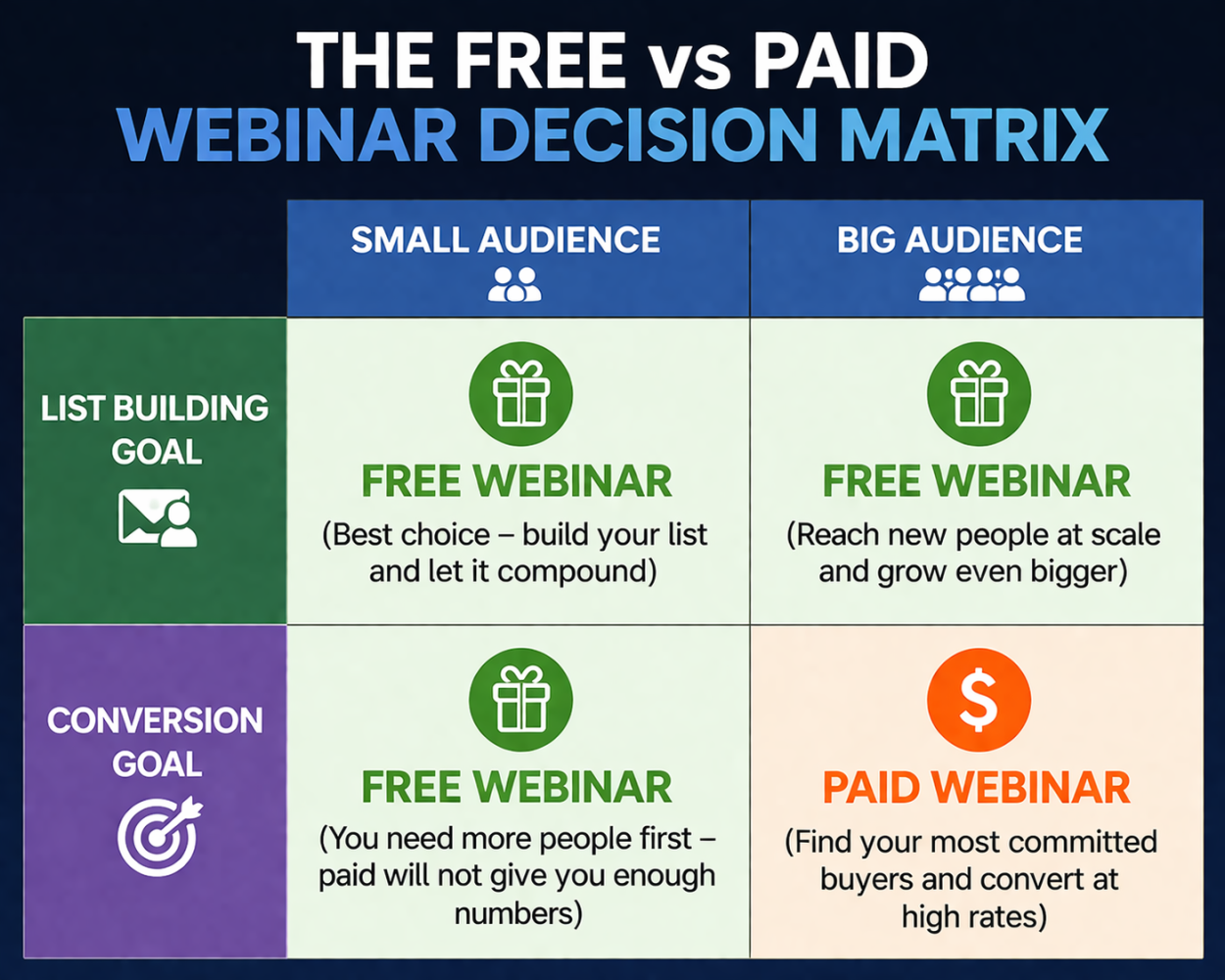
The Free vs Paid Webinar Decision Matrix


Let me make this really simple for you. Think of it as a quadrant.

Small Audience

Big Audience

List Building Goal

FREE WEBINAR (Best choice – build your list and let it compound)

FREE WEBINAR (Reach new people at scale and grow even bigger)

Conversion Goal

FREE WEBINAR (You need more people first – paid will not give you enough numbers)

PAID WEBINAR (Find your most committed buyers and convert at high rates)

As you can see, there is really only one scenario where a paid webinar is the best choice. That is when you already have a big audience AND your goal is conversion.

In every other scenario, free webinars win.


How to Maximise Attendance on Free Webinars

One of the biggest concerns people have about free webinars is the show-up rate. And I get it. What is the point of having hundreds of registrations if only a fraction shows up?

Here are the strategies that have worked for me and my clients to boost attendance.

1. Send a Strong Reminder Sequence

Do not just send one email reminder. Send a sequence. The day before. The morning of. One hour before. And when the webinar starts.

Each reminder should give people a new reason to show up. Share a benefit they will get. Tease a story you will tell. Create anticipation.

2. Make the Topic Irresistible

If people are not showing up, it is usually because the topic does not feel urgent enough. Your webinar title needs to promise a specific outcome that your audience wants right now.

Instead of “Marketing Strategies for Coaches” try something like “The Simple System I Used to Get 20 Clients in 30 Days Without Paid Ads.”

Specificity creates urgency. Urgency creates attendance.

3. Use Partnerships to Fill Your Room

This is one of the most underused strategies out there. Instead of trying to fill your webinar all on your own, find partners who already have your ideal audience.

Reach out and say “I have this presentation that will deliver massive value to your audience. If any sales come from it, we split them.”

Now you are not just relying on your own list. You are tapping into audiences that already trust someone else. And that trust transfers to you.

I started with zero audience. No partnerships. No money. No social media following. But I started building partnerships. And one connection put me in front of hundreds of people at a time.

Every person who registered built my mailing list. Every webinar compounded on the last one. That is how I built my business.

4. Run Webinars Consistently

Do not treat your webinar as a one-time event. Run it consistently. At least twice a month.

When you run webinars regularly, you give people multiple chances to show up. The person who did not attend the first time might attend the third time. And by then, they already know your name and trust you more.


How to Maximise Engagement During Your Webinar

Getting people to show up is only half the battle. The real magic happens when they are engaged the entire time.

Here is how to keep your audience locked in from start to finish.

Start With a Story

Do not start with a pitch. Do not start with a slide full of bullet points. Start with a story.

When I started my career, I was serving in restaurants. I moved from Italy to the UK barely speaking English. Now I have generated over 3 million pounds through the power of speaking and webinars.

That kind of story creates connection. It makes people think “If he can do it, maybe I can too.” And once they feel connected to you, they stay.

Teach Something They Can Use Immediately

The best webinars give people a quick win. Something they can implement today and see results from.

If your entire webinar is theory and concepts, people will zone out. But if you show them a step they can take right now, they lean in. They take notes. They stay until the end.

Ask Questions and Create Interaction

Do not talk AT your audience. Talk WITH them. Ask questions in the chat. Run quick polls. Get them participating.

When people are actively involved, they are 10 times more likely to stay on the webinar and 10 times more likely to buy.

Be Authentic, Not Salesy

This is something I feel very strongly about.

Nobody wants to sit through a webinar that feels like one long sales pitch. People can smell it. And they leave.

Instead, focus on serving. Give your best stuff. Be honest about what works and what does not. Show them you genuinely care about their results.

When you do that, selling becomes easy. Because people want to work with someone they trust.


How to Maximise Sales From Your Webinar

Whether you run a free or paid webinar, the ultimate goal is to create clients. Here is how to make that happen without feeling pushy or manipulative.

Focus on the Problem, Not the Product

Before you talk about your offer, make sure your audience deeply understands the problem you solve. When people feel the weight of their problem, the solution becomes obvious.

Do not rush to the pitch. Let the problem do the heavy lifting.

Present Your Offer as the Logical Next Step

Your offer should feel like the natural continuation of what you just taught. Not a random product bolted onto the end.

If you taught them the “what” and the “why” during the webinar, your offer is the “how.” It is the vehicle that takes them from where they are to where they want to be.

Use Social Proof

Share stories of real people who have used your system and got results. Not hype. Not inflated numbers. Just honest stories of transformation.

Social proof removes doubt. It helps people see themselves in those success stories. And it makes the decision to buy so much easier.

Do Not Stop After the Webinar

Remember what I said earlier. The majority of your revenue comes AFTER the webinar.

So have a follow-up sequence ready. Send emails. Share replays. Offer one-on-one conversations for people who are interested but not sure yet.

The webinar is the start of the relationship. Not the end.


The Compounding Strategy: How One Webinar Builds Your Entire Business

Let me paint the picture of what happens when you use webinars the right way.

Month one. You run a free webinar. 100 people register. 35 show up. You make 3 sales. That is great. But the real win is that you now have 100 people on your list.

Month two. You run the same webinar again. You invite your list plus new people. 150 register. 50 show up. You make 5 sales. Some of those sales come from people who registered last month but did not buy.

Month three. 200 registrations. 70 attendees. 8 sales. The compound effect is kicking in.

By month six, you have a list of 500 plus people. You know your webinar inside and out. Your conversion rate is getting better every time. And you have a predictable system for getting clients.

This is the power of free webinars done consistently. Each one builds on the last. The momentum is unstoppable.

Now imagine you started with a paid webinar instead. Month one, 15 people register. 12 show up. You make 2 sales. But you never capture the other 85 people who would have registered if it was free. You never build the list. You never create the compound effect.

That is the difference.


Common Mistakes to Avoid

Before I wrap up, let me share the biggest mistakes I see people make with webinars.

Mistake 1: Choosing Paid Too Early

If you have less than a few hundred people in your audience, a paid webinar is going to be an uphill battle. Build your audience first with free webinars. Then test paid once you have the numbers to support it.

Mistake 2: Running a Webinar Only Once

One webinar is not a strategy. It is an event. To build real momentum, you need to run webinars consistently. Twice a month at minimum.

Mistake 3: Making It All About the Sale

If your webinar is just a glorified sales pitch, people will leave and never come back. Lead with value. Serve first. The sales will follow.

Mistake 4: Ignoring the Follow-Up

Most of your revenue comes after the webinar. If you do not follow up, you are throwing money away. Simple as that.

Mistake 5: Trying to Do It Alone

You do not need to figure this out by yourself. Find partners who can help you fill your webinars. Join communities where you can learn and grow together.

That is exactly what we do at GTeX. We help experts and companies create webinars that convert without sounding obnoxious. And we do it together.


Your Next Step

If you are just starting out or you do not have a large audience yet, start with free webinars. Build your list. Build relationships. Let the compound effect work its magic.

If you already have a big audience and want to find your most committed buyers, test a paid webinar. See how it performs. You might be surprised at the results.

And no matter which route you choose, remember this. The goal of every webinar is to serve your audience so well that working with you becomes the obvious next step.

If you want a head start, check out the Webinar Conversion Kit.

[CLICK HERE TO GET THE WEBINAR CONVERSION KIT]

You get all my templates, frameworks, and a sprinkle of AI to help you create a high-converting webinar presentation. It is the fastest way to get your first webinar up and running.

Together we grow exponentially.

Simone Vincenzi |  Founder, GTeX

Harnessing Winter for Growth: Turning Dark Days into Opportunities for Inner Renewal

Harnessing Winter for Growth: Turning Dark Days into Opportunities for Inner Renewal

Harnessing Winter for Growth: Turning Dark Days into Opportunities for Inner Renewal

As winter arrives and daylight hours shrink, many of us feel the seasonal impact on our mood, energy, and productivity. Globally, millions experience winter-related mood changes: in the UK, around 3% of the population faces Seasonal Affective Disorder (SAD), with a further 20% reporting milder winter blues. 

Similarly, in northern Europe, where daylight can drop to only a few hours in winter, seasonal dips in energy and mood are widely felt. And in the U.S. studies have shown that about 5% of adults also experience this disorder, with many more feeling a general dip in mood and productivity as the winter months settle in. 

For entrepreneurs, coaches, and mentors, this season brings unique challenges but also a powerful opportunity for inner growth and recalibration.

This article explores ways to turn winter’s challenges into chances for reflection, habit-building, and renewal. Let’s come together to support one another by sharing tips, routines, and insights that help us embrace this season with resilience. How can we transform the quieter months into a time of reflection and growth? Share your experiences and strategies, so we can all make the most of this season.


Izabella Niewiadomska

Fleur Sclarandis

Website: www.fleursclarandis.com

Substack: https://wordstonourishyoursoul.substack.com/


“How do you keep your energy and motivation up during the darker months? Is there a specific practice or habit that’s been especially helpful for you?”

I get outside every day for fresh air and go for a walk, ideally in nature or at least away from busy roads if possible. Moving your body is crucial for physical and mental well-being, as well as creativity and cognitive functioning. If the weather is going to drain me more than energise me, or if I can’t get out in daylight hours, I’ll be sure to move around indoors doing some exercise “snack bites”. I also do yoga 5 times a week, ideally for an hour, but consistency is about adaptability. You have to work with what you have. 5 minutes is better than nothing. 


“How do you balance productivity with self-care during winter months? What’s one strategy that’s helped you avoid burnout during this season?”

Slow down and pull back! Slowing down gives you space to think, helps you act more mindfully and conserves energy. You will naturally have less energy when it’s colder and darker. Don’t fight it, adapt to it. Recalibrate your expectations, and be intentional about where your energy is going. Less is more!


“Have you discovered any unique ways to stay connected with others or feel more positive during winter? What advice would you give someone struggling with the seasonal shift?”

I used to hate winter. The lack of light, warmth, energy, and blue skies drains me. But, we can’t change ‘what is’. So, I’ve learnt to embrace the gifts of winter-: a time for rest, softness, surrender, going slowly, scaling back on socialising (unless it’s nourishing), reflecting, tending to your home, and filling up your cup. 


If you’re struggling, as far as you can, be sure to move your body. This is key! Try to get outside as much as you can. Invest in a SAD lamp if you’re not getting enough light. Investigate if it’s worth trying vitamin D and C during the darker months.  Do the things that nourish you. Be easy on yourself and lower your expectations. We aren’t meant to be ‘rushing now’! Allow yourself to rest more or to have ‘lazy days’. You don’t have to be in ‘busy’ or ‘productive’ mode all the time. Now is the time to hunker down. Scale back any non-essential activities. If you fancy a cosy read, you might want to curl up with ‘Wintering’ by Katherine May. 


Take time to sow the seeds of your intentions, but be patient. Finally, stop waiting and wishing for summer to come. Don’t wish your life away, or  Life is happening now. There’s no reverse. This season has value, it’s up to you to define it. 


“In times when we thought ourselves indolent we have discovered afterward that much was accomplished and much was begun in us.” – Ralph Waldo Emerson


Chad Norgard

Claire Bagehot

Website: https://www.rawnchiliving.com

Facebook: https://www.facebook.com/clairebagehot


“How do you keep your energy and motivation up during the darker months? Is there a specific practice or habit that’s been especially helpful for you?”

I focus on the Inner Game, it’s part of my work with clients. 

I have one objective in life, and from that everything filters down to establish goals, aims, that then determines what habits I create and nuture within myself.

A practise / habit I cultivate is curiosity, and that curiosity in everything naturally and organically drives everything I do, so I don’t need to motivate myself – that is such hard work and is highly energy inefficient long term.  

I help my clients find their own perpetual motion energy source within too, so working towards goals etc is not an uphill struggle but a creative challenge that gets them fired up about it and raring to go.


“How do you balance productivity with self-care during winter months? What’s one strategy that’s helped you avoid burnout during this season?”

There is no particular strategy that will avoid burnout as I find strategies are like ‘managing stress’, and an ineffective way of doing things. 

Creating a life philosphy that carries you throughout whatever season it is externally and internally is the best foundation to build.

Balancing productivity with self care during any season is down to identity, and how strongly you identify with your work, how deeply you know yourself and how well you understand that you are not your work.

There is an enormous amount to this, and although the concept is super simple most people have no idea what it means or how to go about it, hence losing themselves and burnout (which most actually do not realise they are going through).


“Have you discovered any unique ways to stay connected with others or feel more positive during winter? What advice would you give someone struggling with the seasonal shift?”

I feel that staying and feeling connected to yourself first and foremost is the most important thing. 

You can be in the most supportive and uplifting positive community and still feel totally alone, rejected, abandoned. 

The Inner Work, the Inner Game is absolutely fundamental to being able to reach out to people in the first place. So many do not reach out because deep inside they do not feel they can, for a myriad reasons. 

Aside from that, communities are super important. 

Finding a community of like minded people, where you feel you belong, people that understand what you’re talking about, your ethos and philosophy in life, your beliefs and dreams, goals and desires. 

That community may be small or large, or you may have several communities who cater to different aspects of you. 

For someone struggling, finding a professional with whom you have a rapport and can work through things is also fundamental to be able to help guide you with great tools, techniques, etc will take the pressure off needing others like family or friends to help you solve issues as they often do not know how best to support someone as they are too emotionally attached and close. 

On a lighter note, the days have already started to ‘get longer’ and spring will be here soon, getting out into the daylight into nature and going to places that are not your usual stomping grounds will help activate certain parts in the brain that get stimulated by the newness of things, something different to see, which then awakens the brain into looking at your usual environments through different eyes, you’ll notice things you had forgotton about, or see things you never noticed before. 

It’s a great brain hack for any time of year, but especially now.


Claudia Romero

Claudia Romero

Website: https://claudia-romero.com/

Linkedin:  https://www.linkedin.com/in/claudiaromerocoaching/


“How do you keep your energy and motivation up during the darker months? Is there a specific practice or habit that’s been especially helpful for you?”

To keep my energy and motivation up during the darker months, I focus on movement, mindfulness, and meaningful connection. Getting outside for a walk, even on the coldest days, is non-negotiable for me (although I skip it if it is raining too hard…Scottish weather can be harsh!). Nature always gives me a fresh perspective, new ideas, and a much-needed reset when the shorter days start to feel heavy. There’s something about the crisp air, the changing scenery, and the simple act of moving that clears my mind and boosts my creativity.

 I also practice mindfulness daily, whether through meditation, deep breathing, or just being fully present in whatever I’m doing. It helps me stay grounded and prevents me from slipping into the sluggishness that winter can sometimes bring.


“How do you balance productivity with self-care during winter months? What’s one strategy that’s helped you avoid burnout during this season?” 

A great way to balance productivity with self-care during winter is by aligning your schedule with your natural energy levels. I personally embrace Controlled Procrastination—allowing myself slower starts on darker mornings, where I take time for meditation or exercise, go for long walks while listening to podcasts, and then ease into focused work after lunch. Knowing yourself and your rhythm is key to making the most of your day. This approach removes the guilt of low-energy periods while still maintaining productivity. I also set just a couple of key goals each day to avoid overwhelming or overloading my schedule.

One strategy that has helped me avoid burnout is effective planning—treating winter as a season for reflection, deep work, and recalibration rather than expecting the same fast pace as busier months. I prioritise rest, nourishing meals, and outdoor breaks to keep both my mind and body in check. But the most important habit? Making time for myself. Every day, I carve out at least an hour just for me—not for work, family, or anyone else. Whether I choose to read, exercise, or simply stare at a blank wall (yes, really!), I do it without guilt. And I’ve found that by consistently honouring this time, I’m far more productive than when I push myself to the limit, only to fall short of what I intended to achieve.


“Have you discovered any unique ways to stay connected with others or feel more positive during winter? What advice would you give someone struggling with the seasonal shift?”

Absolutely! Staying connected during winter is essential, and for me, that means intentionally making time for quality moments with family and friends—whether that’s cosy dinners, nights out, or simply long chats over a cup of coffee (or something stronger!). I also love going for walks, even when it’s cold, because fresh air and good conversation can work wonders for lifting my mood.

For anyone struggling with the seasonal shift, my advice would be to lean into connection and joy—don’t isolate yourself. Plan regular meet-ups, even if they’re virtual, and prioritise activities that bring warmth into your days, whether that’s cooking a comforting meal, listening to uplifting music, or making time for hobbies that light you up. And most importantly, be kind to yourself—winter isn’t about forcing productivity but about embracing the season with balance.


Jo Farmer

Jo Farmer

Linkedin: https://www.linkedin.com/in/jo-farmer-mlib-83689816/


“How do you keep your energy and motivation up during the darker months? Is there a specific practice or habit that’s been especially helpful for you?”

Spending down time as an autistic person helps to control energy levels.  Having an idea of what you need to do when you have energy and breaking it down to jobs, and doing it when you can.


“How do you balance productivity with self-care during winter months? What’s one strategy that’s helped you avoid burnout during this season?”

Doing craft activities helps unwind and think.


“Have you discovered any unique ways to stay connected with others or feel more positive during winter? What advice would you give someone struggling with the seasonal shift?”

Social media groups are good for sharing feelings and not feeling alone.


Deborah Maw

Deborah Maw

Website:  http://deborahmaw.com


“How do you keep your energy and motivation up during the darker months? Is there a specific practice or habit that’s been especially helpful for you?”

Getting outside during daylight hours, particularly when the sun is shining. We so need sunlight, just like plants, and yet most of us spend the winter under artificial lighting.


“How do you balance productivity with self-care during winter months? What’s one strategy that’s helped you avoid burnout during this season?”

Sleep and rest. Winter is a time to semi-hibernate. Before electric lighting people would go to bed shortly after dark and not get up until dawn. In the summer with shorter nights people would be more active. Winter is a time to rest.


“Have you discovered any unique ways to stay connected with others or feel more positive during winter? What advice would you give someone struggling with the seasonal shift?”

Get outside, preferably in nature, minimum 20 minutes a day. The pace and noise of modern life is exhausting. We need to ground ourselves, just like the earth pin on a plug.


Final Thoughts


Winter may slow our pace, shorten our days, and challenge our energy, but within this season lies a hidden gift, an opportunity for deep reflection, growth, and renewal. Just as nature rests to prepare for new blooms, we too can use this time to recharge, recalibrate, and realign with what truly matters. By embracing winter’s rhythm, rather than resisting it, we create space for intentional habits, meaningful connections, and the clarity needed to step into spring with renewed strength and purpose.


From Goals to Growth: How to Close the Year Strong and Set Up for Success in the New Year

From Goals to Growth: How to Close the Year Strong and Set Up for Success in the New Year

From Goals to Growth: How to Close the Year Strong and Set Up for Success in the New Year

As the year winds down, many of us are taking a moment to reflect on our goals – both achieved and still in progress; our challenges, and the lessons we’ve learned along the way.

Studies show that while around 60% of people set goals at the start of the year, only about 8% see them through.

For entrepreneurs, coaches, and mentors, closing out the year with thoughtful intention can make a meaningful difference, not just in reaching specific goals but in creating lasting growth and momentum.

This time of year provides a valuable opportunity to celebrate milestones, learn from setbacks, and refocus our priorities.

By embracing practices that help us close the year with clarity and prepare for the future, we can start the new year with renewed energy and purpose.

In this article, we’ll explore some effective strategies for evaluating the year gone by and creating a vision for success in the year ahead.

We invite you to join the conversation: what has helped you stay on track, and what are your go-to tips for planning the year to come?

Let’s come together to share insights, inspire each other, and ensure that we’re all ready to take on the new year with confidence and clear direction.

Watch the interview and read the full article below.

Maya Mendoza

Claire Bagehot

Facebook:  https://www.facebook.com/clairebagehot

Website:  https://www.rawnchiliving.com


What is the best way you have found to reflect on the end of the year?

I have a morning routine that keeps me on track as well as reflecting each day / week etc on my progress to date. So, about September time I’m already planning the next year’s achievements and accomplishments.

This way, I don’t need to do what many people try to do and work out what happened over the course of the year, I know intimately where I am at any given moment.

The end of the year is extremely satisfying for me as I play in the present moment (and enjoy what I’ve done and who I’ve become) whilst building the future at the same time.

I don’t need to review the year as such as it’s an ongoing process for me.


How can entrepreneurs start the New Year on the right foot?

If they haven’t already, gather all the gold from successful accomplishments and achievements as well as from things that ”failed”, ”flopped”, ”didn’t work”, do the inner work to clear any crud out, and then map out what you need to, want to, desire to and think you will never accomplish – very different energies and levels of thinking, being and moving within action.


Carol Anne Cooper

Suze Maclaine Pont

Website:  https://suzemaclainepont.com/


What is the best way you have found to reflect on the end of the year?

I have a ritual at the end of November where I look back for three full days off grid.

On day 1, I first look back at my goals that I had set for the year at the start. Then I journal around why I wanted that, how I approached it and what happened. I write everything that happened, good, bad, ugly, unexpected, then I make a vision board for the past year.

On day 2, I contemplate on the vision board and what happened and I answer a whole bunch of questions enabling me to see where my survival patterns might still be running the show, where my Divine Self is actually taking over, what patterns are unfolding and how I can see them show up – sometimes in small actions, sometimes in big results.

On day 3, I then start to journal and vision around what I want to create for the next year and I start to look at what I might need to learn, how that might show up and how I can speed my learning up…


How can entrepreneurs start the New Year on the right foot?

By allowing more of who they ARE as human beings into their work, instead of trying to ‘make results’ so that they feel happy, allow more happiness to fuel the results.,, this process works. I do a version of this every 3 months and at the end of the year this big process, sometimes a full week. We can be so busy ‘getting things done’ that we often forget that WE are the ones doing it.

So this self care of ‘where am I in all of it’ is not just ‘important’, it IS the actual work. Your clients buy who you are BEING while you do what you do. Never forget that!


Arti Shah

Sorrel Pindar

Website: www.sorrelpindar.co.uk

Linkedin: https://www.linkedin.com/in/sorrel-pindar-a439783a/


What is the best way you have found to reflect on the end of the year?

For me the best way to reflect on the end of the year is to take time out, stop everything and let my thoughts settle. This means being single-minded about setting time aside which is protected from the demands of the rest of the world!

Journaling can be a useful tool here: Dedicating one or two pages to each month of the year where I can note down the challenges, the things that went well and the things that I would do differently next time.

Then I can look back through the year and see my trajectory from January to December. What was I doing at the beginning of the year and what’s different now? How have my vision and therefore my intentions and goals changed?

This serves as the basis for a projection into the next year, but more importantly it gives me a chance to notice how much I have achieved and the challenges I’ve faced.

How can entrepreneurs start the New Year on the right foot?

Start by recognising that if you live in the Northern hemisphere, it’s cold, it’s dark and the days are short, so hibernation is important. Respect the cycle of the seasons and take the opportunity to let things sit quietly. New Year’s Resolutions are just a way to set yourself up to fail – so don’t make any!

January is a good time for reflection and for dreaming. Dream big, without feeling you have to do anything. This is a time to just be. In that state of being, your dreams will start to develop into plans which will eventually become goals and intentions.

As the days get longer we come out of that slowed-down state. You can start to take action on some of those dreams and intentions. Whatever you do, do it because it feels right at this moment, not because of a need to push. And by March 21st it’s time to set some Equinox Resolutions!


Veronica King

Fleur Sclarandis

Website:  www.fleursclarandis.com

Instagram: @fleursclarandis


What is the best way you have found to reflect on the end of the year?

By going inward, and doing some self-reflection alone first. Ask yourself specific questions and journal those answers with curiosity and compassion. E.g.: Write what you achieved, what you’re proud of, lessons learned, etc. And, then gather together in a small, intimate group that feels safe, with people who are in this arena with you (that is key!), and together share your answers, insights, and intentions.

There’s something really powerful about sharing with others that really brings out ideas, feelings and inklings that only come forth in safe, intentional conversations with like-minded people. Plus, you get lots of encouragement too, and that goes a long way!


How can entrepreneurs start the New Year on the right foot?

By taking time to relax, reflect and rest and prioritising that! Remember that it’s never really about what you get or achieve or the numbers you make- it’s all about who you become and the lives you touch in the process of striving towards your business goals.

So, once you have made time to rest and stop – because there is power in stopping, and it’s when your best ideas come in – come back to your ‘why’, cut out the noise, and keep it simple. Be sure to make a strategic plan that aligns with your values and how you like to work… but hold it lightly!

Finally, make time to think and journal about who is ‘the future you’ who has achieved your desired impact- step into the new year with the confidence that the world needs your dose of authentic magic! No one can do what you do in the way you do it.

Finally, remember that you have to LOVE what you offer… so follow the excitement and remember that ‘selling is simply the transfer of enthusiasm from one person to another!’

Dawn Friedman

Danielle Silverman, MBA, M.A., ACC, CRP

Website:  https://www.reinventing-u.com/

Linkedin:  https://www.linkedin.com/in/daniellesilverman/


What is the best way you have found to reflect on the end of the year?

For me, the best way is to go back and think about all of the things that have happened throughout the year. I usually write things down, as they come back more easily that way. I start with some of the big things that pop up and usually go from there. In the case of this year 2024, there were many big things, not all of them good. Then I reflect on what happened and how it affected or changed me.

This year started off with a bad accident and it led me to reflect on the value of self-care and self-love. We talk about this very often but seldom do we take action. This was the year that I understood the value of self care. After having coached clients over the years using the story of how, when there is depressurization in an airplane cabin, it’s essential to put the mask on yourself first, so that you can be in good enough shape to help others, I found I had to live it myself.

Ultimately, as human beings, we are alone, even if we are in a partnership. As entrepreneurs, we may have people we work with who support us in various ways, with technology, writing, administration, or other tasks. But we are ultimately responsible for ourselves. There is no one who is going to wave a magic wand and make things happen for us.

When I learned that I would not be having a back operation this year, that turned things around completely.

Events happen, some of them small, some of them big, some of them good, and some of them not so good. In my case they were not so good, but the lessons I took away from these situations are: 1) Care for myself first if I want to succeed. 2) To succeed means actually doing something. It won’t happen by itself. 3) Examine all of the things around me and reflect on what is going on. Reflect on what I need and what I can let go of. Reflect in particular on what is holding me back. What am I holding onto that I no longer need and that is actually weighing on me and keeping me from moving forward.

I remember having a conversation with someone and telling them that I had just bought a new laptop, but hadn’t had time to install everything. It was weighing on me but I had so many other things to do that I didn’t consider that a priority. Well, in fact it was not only a priority, it was the TOP priority, because without this new laptop, I would not be able to be productive in what I wanted to do.

I did a lot of re-organizing and getting rid of things this year. Many, many things. From clothes that no longer fit, to files I no longer need to keep. Most of it got cleared away. And in their place came new ideas, new energy, new visions of what could be, and new clients.

This process is what Reinvention is all about. It is about constantly re-evaluating a situation and taking stock. Determining what works and what doesn’t work and making a decision about what to keep and what not to keep. It is about breathing life into a system.

In 2024, I breathed life into my system, into my physical being and my physical surroundings. It created space in my brain and  increased energy such as I have never experienced before.

I highly recommend this kind of deep personal reflection – it begins with awareness and a desire to take care of oneself first.


How can entrepreneurs start the New Year on the right foot?

I would start with a reflection on everything that has happened throughout the past year. Journal about it and make a conscious decision to look at each major event and analyze it. Ask powerful questions such as: What worked? What prompted me to say/do/think in a certain way? What feedback did I receive and how did it affect me? What could I have done differently? What would I not change? What went well and what was the reason it went well? Where did I put my energies and where do I really want to put my energies? How can I get more energy? What kind of support do I need?…I could go on. The vision of what we want to do in 2025 will come out of this reflection. Expand your self awareness and awareness of your surroundings.

Look at it as a transformation. What stage of the butterfly are you in? Are you still in the cocoon? Are you the egg, larva, pupa or adult? What does each stage represent and what is the ultimate transformation that you would like to seek.

When I first joined GTeX, I heard Simone say that our Vision is not about what we want to do. Rather, it is the vision of the kind of world we want to live in. I remind myself of this every single day. That is my purpose. To make this place a better world for others. And the only way to do that is to begin by making it a better world for me to live in.

I have to say as well, that much of my own personal reflection worked because I had two very special groups that I met with on a regular basis weekly or twice a week, as well as a supportive community. Being able to share ideas, fears, successes, anything in fact in a safe and supportive space has been critical and most beneficial. I highly recommend finding a small group of people that will support you, defend you, and hold you accountable.


Linda Sage

Riikka Manninen

Instagram:  @reflector_astrology


What is the best way you have found to reflect on the end of the year?

I use mindfulness to clear any limiting doubts, beliefs and mindset blocks. I try to do a daily journaling session where I work through anything that comes up in the moment. Reading through my past thoughts, fears and doubts, and also the creative solutions give such a sense of accomplishment. Wow, I worked through all that and look where I am now!


How can entrepreneurs start the New Year on the right foot?

Connecting with the bigger picture of your work is a great way to give direction and motivation for the year ahead. I believe we all are here to answer a calling and serve the greater good. I have a mantra I say before all my sessions: “May I use all my knowledge, skills, wisdom and love for the highest good of all beings concerned. May all your dreams come true and may you be happy, be peaceful, be loved.”

Marjorie Gutierrez

Ben Chai

Instagram:  BenCHaiOfficial


What is the best way you have found to reflect on the end of the year?

By having daily, weekly and monthly reflections


How can entrepreneurs start the New Year on the right foot?

By understanding themselves and what their passions and motivations are.  Once they know these- they would be unstoppable.

Sian Young

Patience Ogunbona

Website:  www.patienceogunbona.com

Linkedin:  https://www.LinkedIn.com/in/patience-ogunbona


What is the best way you have found to reflect on the end of the year?

Slow down, introspection and consolidate progress whilst adjusting expectations for the new year


How can entrepreneurs start the New Year on the right foot?

Be determined to lead your life, not just live it and live well. Understand what anchors you to purpose and fulfilment


Veronica King

Veronica King

Linkedin:  https://www.linkedin.com/in/veronicaking2/


What is the best way you have found to reflect on the end of the year?

I have found looking back at what I have and have not achieved has been helpful. My biggest regret is that I have not used my systems records such as my CRM for best use, so I cannot track on paper my results.


How can entrepreneurs start the New Year on the right foot?

The best way any entrepreneur can start the New Year is to have a Plan that is executable, for them. Once done, look at whether you are going to need help to execute that plan, and who are the people best placed to help you. This is what I have done for myself.


Veronica King

Paula McNicholas

Linkedin:  https://www.linkedin.com/in/paula-mcnicholas/Will

Website:  https://paulamcnicholas.com/


What is the best way you have found to reflect on the end of the year?

For me it’s answering the questions “what went well” and “what went not so well” but with the emphasis on doing more of what went well. It’s really important to reflect on, and celebrate, the wins you had throughout the year. It’s all too easy for us to focus on the failures or simply to move on to the next goal. Celebrate the wins however big or small along the way.

With your 2025 goals in mind, consider doing the Stop-Continue-Start exercise, this will guide you on which of the activities to focus on for the next year and which to drop.


How can entrepreneurs start the New Year on the right foot?

Not only have your goals set for the year but break these down into milestones along the way, month by month. Then plan your strategy and the activities you need to do to achieve these goals, whose help you might need (team, coach, network etc), and consider who you need to BE in 2025, to achieve these goals. What new success habits will you adopt on a daily basis, to keep you consistent in your pursuit of the next level of YOU!

Implement. Be intentional with your time. Take ACTION every day.


Veronica King

Dr Deborah Maw

Linkedin:  https://www.linkedin.com/in/dr-deborah-maw

Website:  https://deborahmaw.com/


What is the best way you have found to reflect on the end of the year?

To look at my results, compared to my intentions at the beginning of the year


How can entrepreneurs start the New Year on the right foot?

Write down your desires, not so much your goals, but what you want. Writing down our wants is like writing to Santa with our wishes, the universe will conspire to make them true.


Final Thoughts


Loving the variety of ideas here, from keeping track, regularly, all year to just reflecting at the end of the year.

You may have your own methods, for seeing the year out and preparing yourself for the coming year, that have served you well and it might be worth considering a change.

There are so many great tips that would worth experimenting with, mix things up a bit by testing out different ones.

It just might spark new perspectives, new revelations and new ideas.

In wrapping up, it’s clear there’s no one-size-fits-all approach to closing out the year and starting the next with intention.

The ideas shared here remind us that the end of the year is an opportunity to not only reflect but also to evolve.

Whether you stick to what’s worked for you in the past or try something new from these suggestions, the key is to approach it with curiosity and an open mind.

After all, every year brings a chance to refine your vision, embrace growth, and set the tone for the journey ahead.

Here’s to making the most of it!